Mistika article
Aim Assist in osu!: How It Works
Targeted assistance in OSU! It is often presented as “just a little help," but in fact it affects one of the key skills of the game - aim cursor control. Here's how these systems work at a basic level, why they can be difficult to detect locally, and why their use is still a scam.
Mistika Team
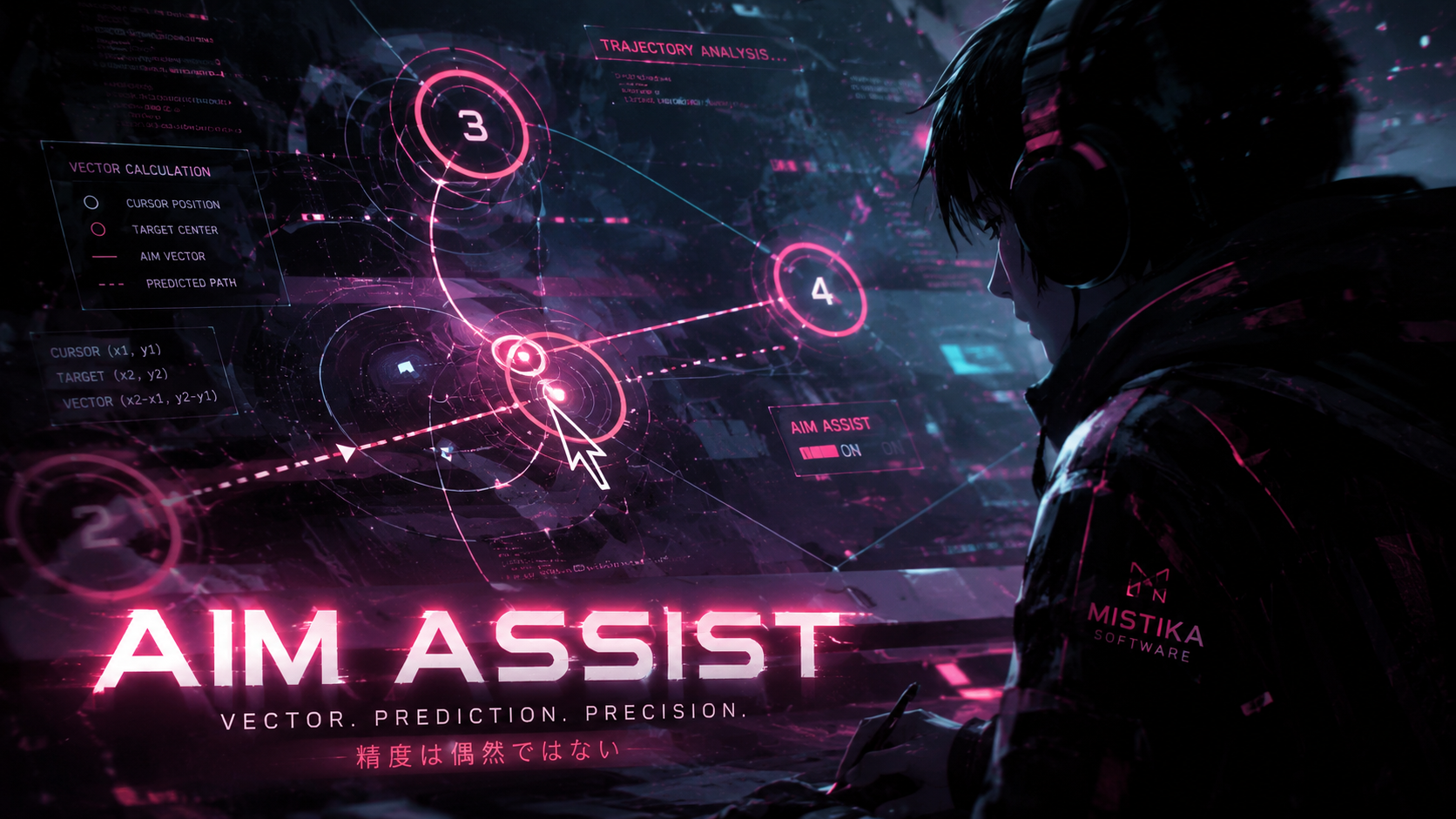
Aim assist in osu! is a tool that helps the player move the cursor toward hit objects. It doesn’t press keys for you — it simply assists with aiming, letting you focus on rhythm, reading, and timing.
That makes aim assist a powerful feature, not just a simple helper.
What Is Aim Assist in osu!?
Aim assist is a system that helps the player move their cursor toward hit objects. In osu!, this directly affects one of the core skills of the game: precision.
Even if the tool does not press keys for the player and only helps with cursor movement, it still gives a great advantage. The player can rely more on their ability to read patterns and hit notes in rhythm, while the software takes care of fine cursor corrections.
This makes aim assist a great tool for gameplay. You get more enjoyment from the process and achieve higher results — beyond what raw mechanical training alone can offer. That is freedom.
How Aim Assist Uses Vectors
At the most basic level, aim assist can be explained through vectors. A vector describes direction and distance. In simple terms, it tells one point how far and in what direction it needs to move to reach another point.
In osu!, this idea can look like this:
- the system detects the current cursor position;
- it identifies the target hit object;
- it calculates the direction from the cursor to the center of the object;
- then it adjusts the cursor movement toward that target.
A very simple movement algorithm could use interpolation, often referred to as LERP. Instead of instantly snapping the cursor to the target, the movement is smoothed over time to make it appear more natural. But that approach is extremely primitive.
Why Some Cheats Do Not Directly Modify the Game
Older cheats often worked by interacting directly with the game process: reading memory, injecting modules, or modifying internal data.
Modern systems may work differently. Some rely on computer vision, meaning they analyze the image on the screen instead of directly touching the game’s memory. In theory, such a tool can look at the screen, detect hit circles or sliders, estimate their position, and calculate a movement path toward them. This can make basic local detection harder, because the tool may not need to inject anything into the game process or modify game files.
But harder to detect does not mean impossible. However, tools built this way are simply more advanced.
Why Anti-Cheat Is Not Only About the Game Client
In osu!, cheat detection is not limited to checking the local client. Score legitimacy can also be evaluated server-side. This may include analyzing player history, performance jumps, replay behavior, cursor movement patterns, unusual consistency, and results that do not match a player’s previous skill level. Even if a cheating tool is not detected immediately, suspicious scores and abnormal behavior can still be reviewed later. Using aim assist is never truly “safe.”
“Undetected” Does Not Mean Safe
Many cheat tools are promoted with claims like “undetected,” “human-like,” “computer vision based,” or “does not touch memory.” These claims do not change the core fact: aim assist gives the player an advantage. Even if a tool tries to look natural, it can still leave behavioral traces: unusual movement smoothing, unnatural corrections, suspicious consistency, and performance that does not fit the player’s history.
However, cheats from Mistika Software are tested for cursor behavior across different devices and are always engineered to be more natural than typical automation. We ourselves have been playing with AimNet and CHIMERA on our main accounts for over a year. Additionally, you can always test the AimNet product yourself.
Final Thoughts
Aim assist in osu! is not as simple as it may seem at first glance.
It is not just a basic cursor helper or a primitive script that moves the mouse toward a circle. Modern aim assist can involve screen analysis, movement prediction, smoothing, trajectory correction, timing-aware behavior, and attempts to imitate human-like input patterns.
It is not just a basic cursor helper or a primitive script that moves the mouse toward a circle. Modern aim assist can involve screen analysis, movement prediction, smoothing, trajectory correction, timing-aware behavior, and attempts to imitate human-like input patterns.
That complexity is exactly what makes it interesting from a technical point of view — and powerful from a competitive one. The more advanced aim assist becomes, the more it blurs the line between small assistance and full automation. But the core idea does not change: if software is correcting your aim in real time, the result is no longer fully yours.
Aim assist is truly a technically impressive feature.