An in-depth technical breakdown of keystroke signal emulation, amorphous polygon collision hitboxes, and Gaussian human rhythm distribution in modern rhythm game cheats.
Quick Overview
What is an osu! Relax Hack?
An osu! Relax hack is an external software tool that automates keypresses whenever the player's cursor hovers over a hit object. Unlike basic macros that trigger on fixed pixels, advanced undetected Relax hacks use randomized amorphous (inkblot) hitboxes, hardware-matched key hold intervals, and Gaussian bell-curve timing distributions to simulate human tapping rhythm and pass anti-cheat inspection.
Introduction: What is the Relax Mod in osu!?
Every osu! player is familiar with the Relax (RX) mod. Selecting it in-game allows players to focus exclusively on cursor aim while the game automatically triggers keypresses whenever the cursor reaches a hit circle or slider.
When translating this functionality into an external cheat software, the core objective sounds straightforward: trigger keypress signals at the right time. However, behind this seemingly simple concept lies a sophisticated software engineering challenge: how do you make automated keypresses look natural, human, and statistically undetected by anti-cheat systems?
1. The Technical Foundation: Operating System Signal Emulation
At the operating system level, pressing a physical mechanical key sends a hardware interrupt signal to your OS containing the scan code of the pressed key.
A Relax cheat functions at its foundational layer as an OS input signal emulator. Whenever we refer to a "key press", we are talking specifically about synthesizing and injecting these low-level OS input events under the hood.
On paper, one might assume a Relax hack is a primitive cheat—just send key signals when the cursor touches a note. However, naive signal injection leads to instant account flagging and server-side replay detection.
2. The Perfection Trap: The Unstable Rate (UR = 0) Problem
In theory, an algorithm could trigger keypresses with absolute mathematical perfection, achieving an Unstable Rate (UR) of 0. However, perfect execution creates two fatal vulnerabilities:
- Cursor Desynchronization: If keypresses fire at fixed mathematical timestamps, the player's cursor might not be hovering over the hit circle at that exact millisecond.
- Instant Anti-Cheat Detection: Server-side anti-cheat algorithms and statistical replay analyzers instantly flag static timing and pixel-perfect hits.
To match human gameplay, the cheat must wait until the player's cursor hovers over the note before triggering a key signal.
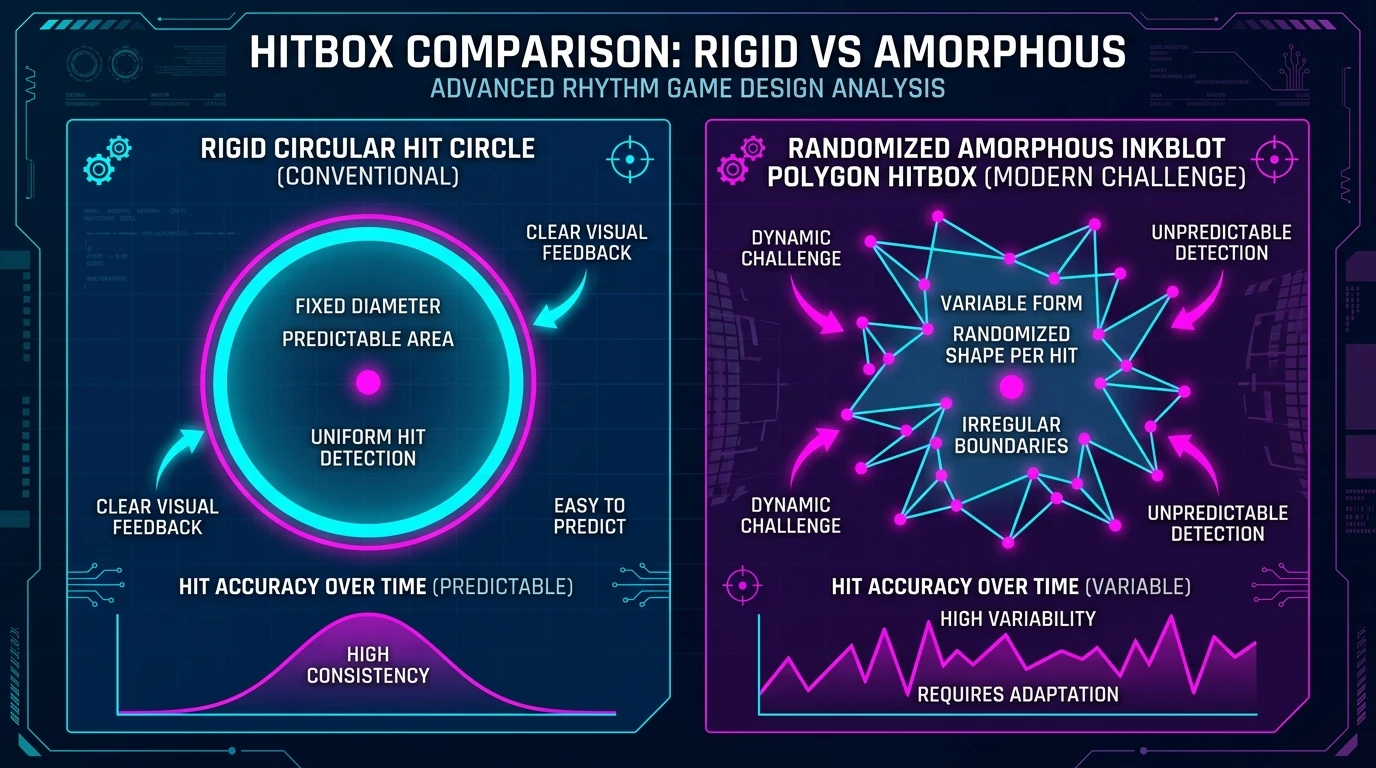
Evasion via Amorphous Inkblot Polygon Hitboxes
If a cheat triggers instantly on the exact outer boundary pixel of a hit circle, it leaves a static, mechanical footprint. Even shifting or shrinking the detection radius results in uniform, detectable thresholds.
To solve this, modern Relax cheats replace rigid circular note hitboxes with dynamically generated amorphous polygons (inkblot shapes):
- Organic Boundary Variance: The collision edge fluctuates unpredictably for every single note.
- Evasion of Pixel-Perfect Checks: Eliminates static radius triggers while maintaining high hit accuracy.
- Natural Aim Simulation: Matches natural human cursor movement and aiming imprecision.
3. Humanizing Keystrokes: Hold Durations & Gaussian Timing Curves
Generating a Key Down signal is only half of a complete keystroke. To finish a tap, the cheat must emit a corresponding Key Up signal. The duration between these two signals is a primary metric monitored by modern rhythm game anti-cheats.
A. Key Hold Duration & Rapid Trigger Hardware Limits
When a human taps a keyboard key, physical switch mechanics dictate reset latency. A completely static or flat random hold duration is easy to flag because key release times cannot be less than the physical return latency of the switch.
Even with modern Rapid Trigger analog switches altering actuation distances, physical key travel limits cannot be zero. Advanced Relax software allows players to define a custom, hardware-matched hold duration range (e.g., 28ms – 44ms).
B. Timing Distribution: Flat Uniform vs. Gaussian Bell Curve
Why is flat pseudo-random timing easy to detect?
If a cheat picks random numbers evenly distributed within a range [min, max], statistical replay analysis exposes the flat probability distribution curve. Real human rhythm skills follow natural biological variance:
Human Rhythm Skill Distribution: Human tapping accuracy naturally clusters around a central mean with a standard deviation, forming a classic Gaussian Bell-Curve Distribution.
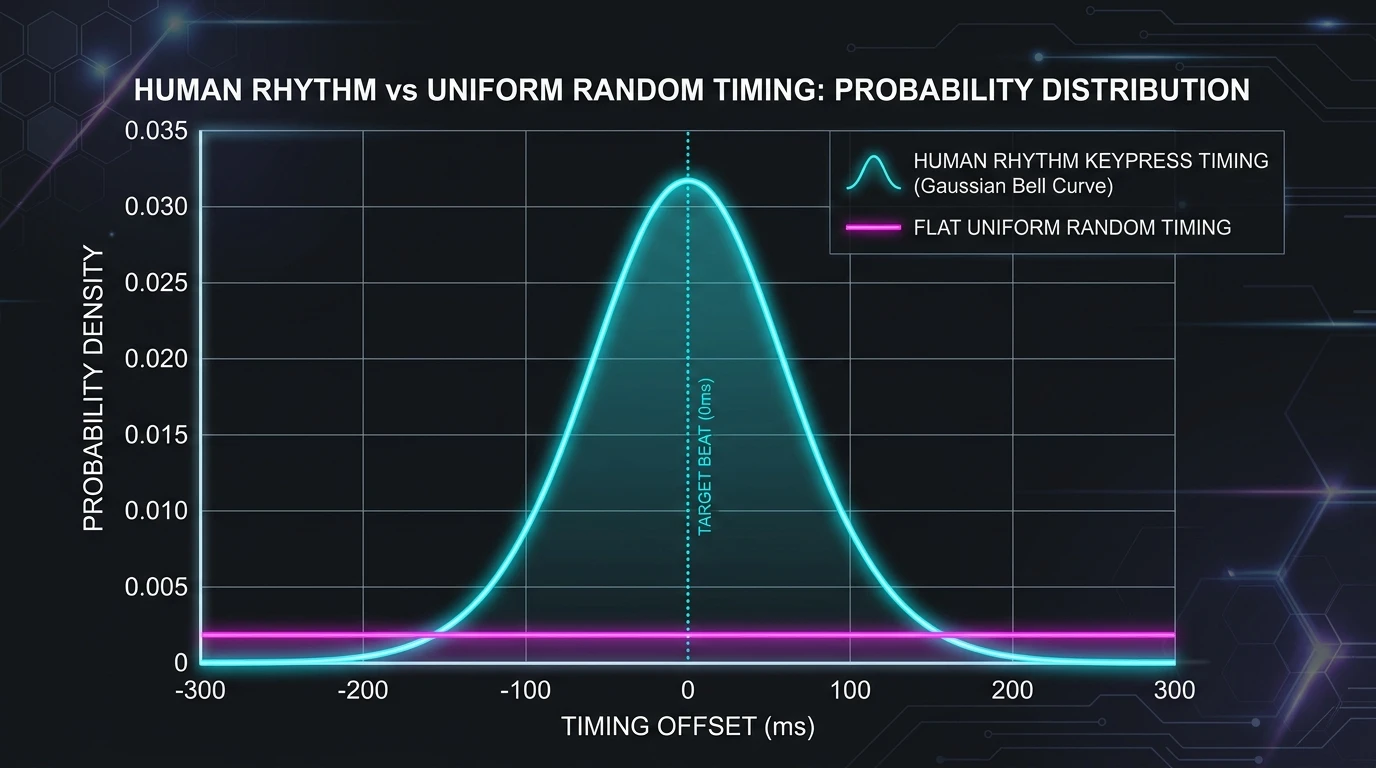
By leveraging the Law of Large Numbers alongside custom pseudorandom number generators (PRNG) tuned to Gaussian curves:
- Keypresses cluster naturally around the beat center.
- Occasional slight early or late hits occur naturally without breaching accuracy thresholds.
- The resulting Unstable Rate (UR) graph perfectly matches top-tier human play.
Frequently Asked Questions (FAQ)
What makes an osu! Relax cheat detectable?
An osu! Relax cheat becomes detectable when it uses static pixel boundary triggers, flat uniform random key hold durations, or perfect 0 UR timing. Anti-cheat systems analyze replay data for non-human statistical patterns.
How does an amorphous inkblot hitbox work in Relax cheats?
An amorphous inkblot hitbox dynamically generates randomized polygon vertices around hit circles. Collision calculations occur against this fluctuating boundary, preventing pixel-perfect hits while ensuring organic aim alignment.
Why is Gaussian distribution important for rhythm game cheats?
Gaussian distribution clusters keypress timings around the center of the beat with realistic human standard deviation, preventing flat statistical probability graphs that trigger automated anti-cheat flags.
Summary: Core Engineering Pillars
| Feature Pillar | Naive / Traditional Cheat | Mistika Relax Architecture | Anti-Cheat Evasion Benefit |
|---|---|---|---|
| Hitbox Geometry | Fixed Radius Circle (Triggers on rigid boundary pixels) |
Amorphous Inkblot Polygon (Dynamic vertex noise per note) |
Eliminates pixel-perfect hit flags & static radius signatures. |
| Key Hold Duration | Static / Flat Random (Unrealistic 0ms return latencies) |
Parametric Range (28ms - 44ms) (Rapid Trigger hardware matched) |
Simulates physical switch release mechanics and hardware return times. |
| Press Timing Curve | Uniform Random Box (Flat probability distribution) |
Gaussian Bell Curve (PRNG) (Law of Large Numbers & Central Mean) |
Replicates human rhythm skill with natural Unstable Rate (UR) clustering. |
Developing an undetectable Relax hack requires advanced mathematical modeling beyond basic signal injection. The Mistika Software engineering team continuously researches pseudorandom distributions and input signal safety to provide the most secure, authentic experience.
Try it all yourself with Mistika Software!